
Insightvault.
The analysis layer — AI-driven analysis and optimisation, where population sentiment is unlocked, examined, and watched for drift.
01 — Visualisation
An energy surface of meaning.
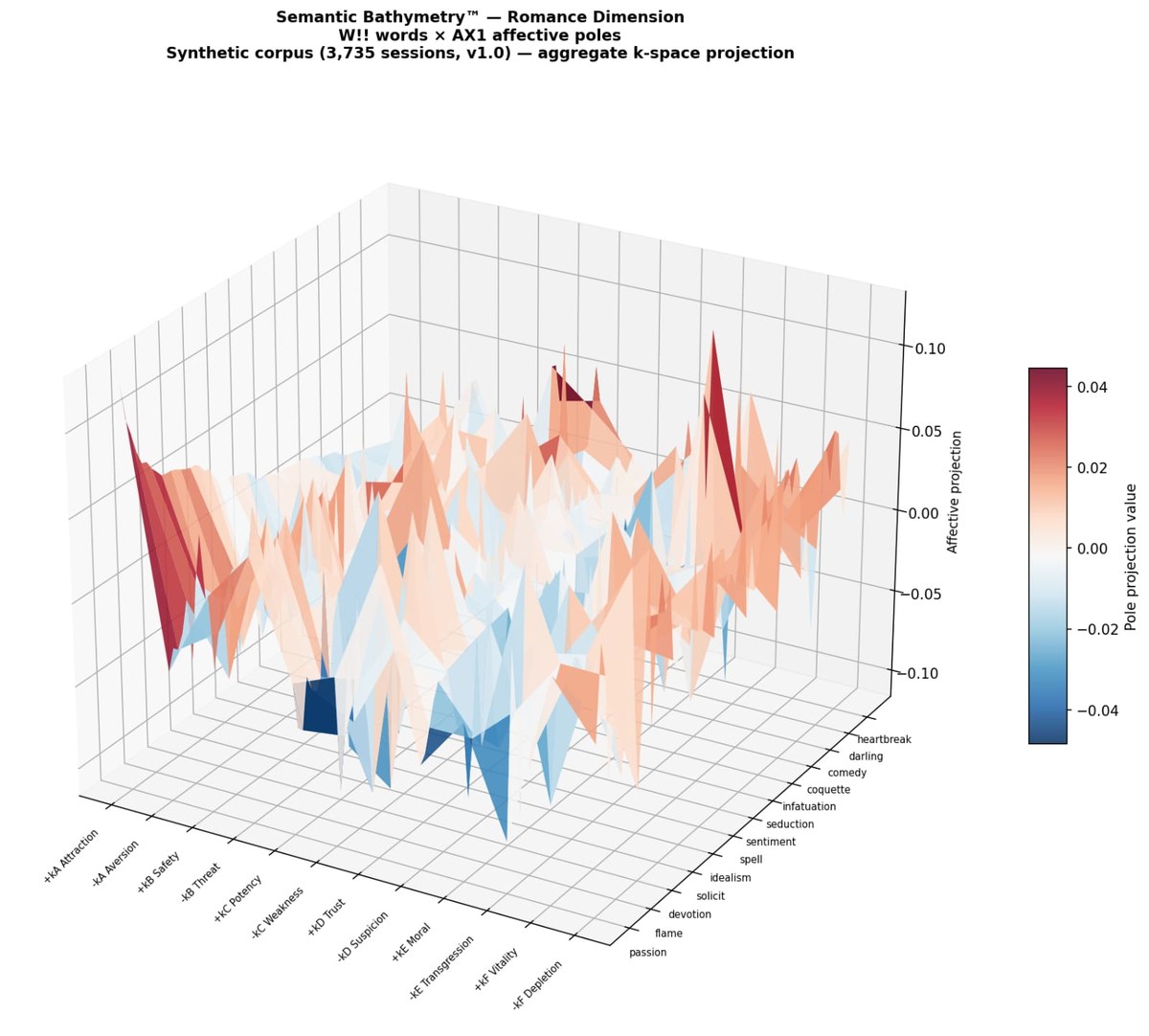
Results are rendered as a Boltzmann-style energy surface: stable, frequently co-activated regions of meaning appear as low-energy attractor peaks, and systematically avoided regions appear as high-energy repulsive basins, giving equal visual weight to what a population approaches and what it avoids.
Each of the six affective axes adopts 10 pole-aligned anchors calibrated against the specific semantic vocabulary of the Dimension under consideration, projecting the anonymised Semba data onto a 60 × 50 reticular topography. In this way a single word such as ‘Heart’ can be seen to have varying affective weight when viewed in different semantic contexts — e.g. Romance, Health and Poker.
02 — PQ
The Peduncular Quotient.
The Peduncular Quotient (PQ) identifies which words in a Dimension's vocabulary act as structural connectors across otherwise distinct regions of meaning, rather than simply which words are chosen most often. It works alongside TILT normalisation, which removes each Dimension's own inherent semantic bias, so that a population's genuine associations — including the words it systematically avoids — can be measured and compared across different Dimensions and over time, rather than being read off raw selection frequency alone.
Canonical examples are words like ‘Bank’ and ‘Kiss’, where the former sits at the junction of otherwise unrelated domains — finance, aircraft manoeuvres and river geography — whilst ‘Kiss’ solves only for ‘Romance’. PQ is what identifies that structural, load-bearing role, rather than treating every word as inevitably belonging to a single semantic neighbourhood.
03 — Periscope
Recursive calibration.
Periscope is the platform's recursive AI calibration layer. Rather than treating demographic and circadian correction factors as fixed assumptions, it models them as parameters to be learned from empirical evidence, updating them from the accumulated dataset on a regular batch cadence.
The use of Bayesian and Monte Carlo techniques allows calibration to be continuously optimised, ensuring that noise filters, semantic correlations and input vocabulary are fine-tuned to reflect poly-dimensional real-world relationships. Together, these are what make the platform adaptive rather than static — quarter-on-quarter drift in the affective landscape is a critically important signal, not noise to be overlooked or filtered out.
If you wish to resonate ‘Trust’ with a Young Woman at Night, the most effective prompt might be ‘Loyalty’; however, for a Middle-Aged Man during the Day, to evoke the concept of ‘Trust’ it might be preferable to refer to ‘Integrity’. This is generally a stable pattern, but over the last 3 quarters Old Women appear to have been migrating their opinion in favour of ‘Integrity’ and away from ‘Romance’.
To bridge the concepts of ‘Trust’ and ‘Quality’, the most effective prompts would be ‘Reliable’ and ‘Consistent’ — but not ‘Compromise’ or ‘Negotiate’.
Charting the depths of human sentiment
See how it's built.
Four progressive layers carry every association from a split-second choice on a user's device to the analysis you've just read about.